Specialized tutoring & Learning Support
Special Education
Math
Individualized Math Tutoring
Discuss:
- Foundational concepts
- Visual representations
- Explicit instruction
- Real-world math
- Problem solving
- Mathematical language
- Scaffolded instruction
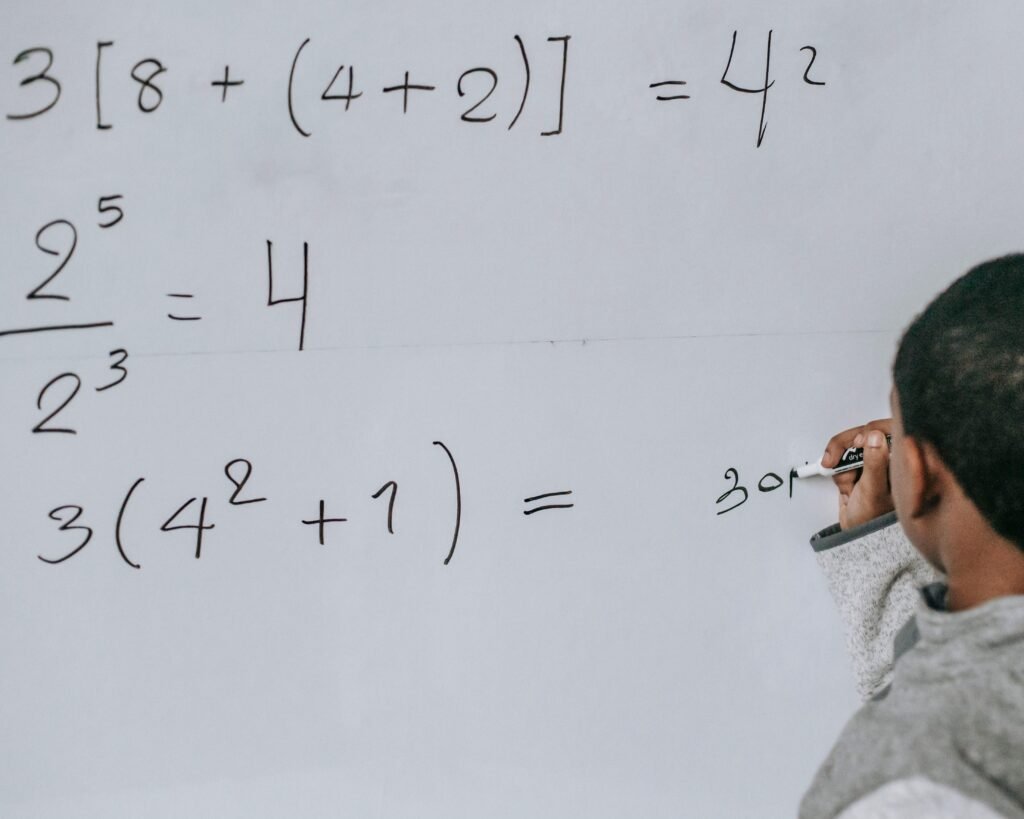
Individualized Math Tutoring for Diverse Learners
Making Math Make Sense—One Discovery at a Time
“I understood it yesterday. Why can’t I remember how to do it today?”
For many families, math homework can become a daily struggle. A learner may understand a concept during a lesson but forget the steps later. Another may solve problems mentally yet struggle to explain the process on paper.
At Adapt Scholar, we believe math is more than memorizing formulas and finding correct answers. It’s about understanding relationships, recognizing patterns, solving problems, and building skills that make sense in everyday life.
Our individualized math tutoring meets learners where they are, helping them develop foundational math skills, strengthen mathematical reasoning, and build confidence through instruction adapted to their learning needs.
Foundational Math Concepts
Strong math skills begin with understanding—not memorization.
Imagine a child who can recite multiplication facts but doesn’t understand what multiplication actually represents.
Memorizing answers may help with a worksheet, but understanding the relationship between numbers creates a foundation for future learning.
We help learners strengthen essential mathematical concepts, including number sense, place value, counting, operations, fractions, decimals, and mathematical relationships.
Through explicit instruction, hands-on activities, and meaningful practice, learners develop a deeper understanding of how numbers work together.
We build upon what learners know while strengthening the skills they need for what comes next.
Visual Representations & Hands-On Math
Sometimes seeing math makes all the difference.
For some learners, numbers and symbols on a page can feel abstract and confusing.
But show that same learner three groups of four objects, and multiplication may suddenly become easier to understand.
Our individualized math instruction uses visual models, number lines, diagrams, manipulatives, and other hands-on learning tools to make mathematical ideas more accessible.
For example, fractions can be explored using fraction strips or everyday objects before moving toward numerical representations.
We help learners connect concrete experiences, visual representations, and mathematical symbols so that understanding develops beyond simply following a procedure.
Explicit Math Instruction
Clear explanations. Meaningful practice. Growing independence.
“Just follow these steps” doesn’t always help a learner understand why a math strategy works.
Some students need the thinking process made visible.
Through explicit math instruction, we break complex concepts into manageable steps, demonstrate strategies, explain mathematical reasoning, and guide learners through supported practice.
A learner struggling with long division, for example, may benefit from watching each step modeled, using a visual checklist, and practicing with feedback before completing problems independently.
Our approach moves from “Watch how it’s done” to “Let’s try it together” to “I can do this myself.”
Real-World Math & Everyday Life Skills
Math becomes meaningful when learners see where it belongs in their lives.
Math doesn’t stop when the school day ends.
It’s in grocery shopping, cooking, budgeting, measuring, managing time, comparing prices, and planning activities.
At Adapt Scholar, we connect mathematical learning to real-world situations that matter to each learner.
A student learning fractions might measure ingredients for a favorite recipe. A teen learning percentages might calculate a store discount. A young adult developing independent living skills might practice budgeting for groceries